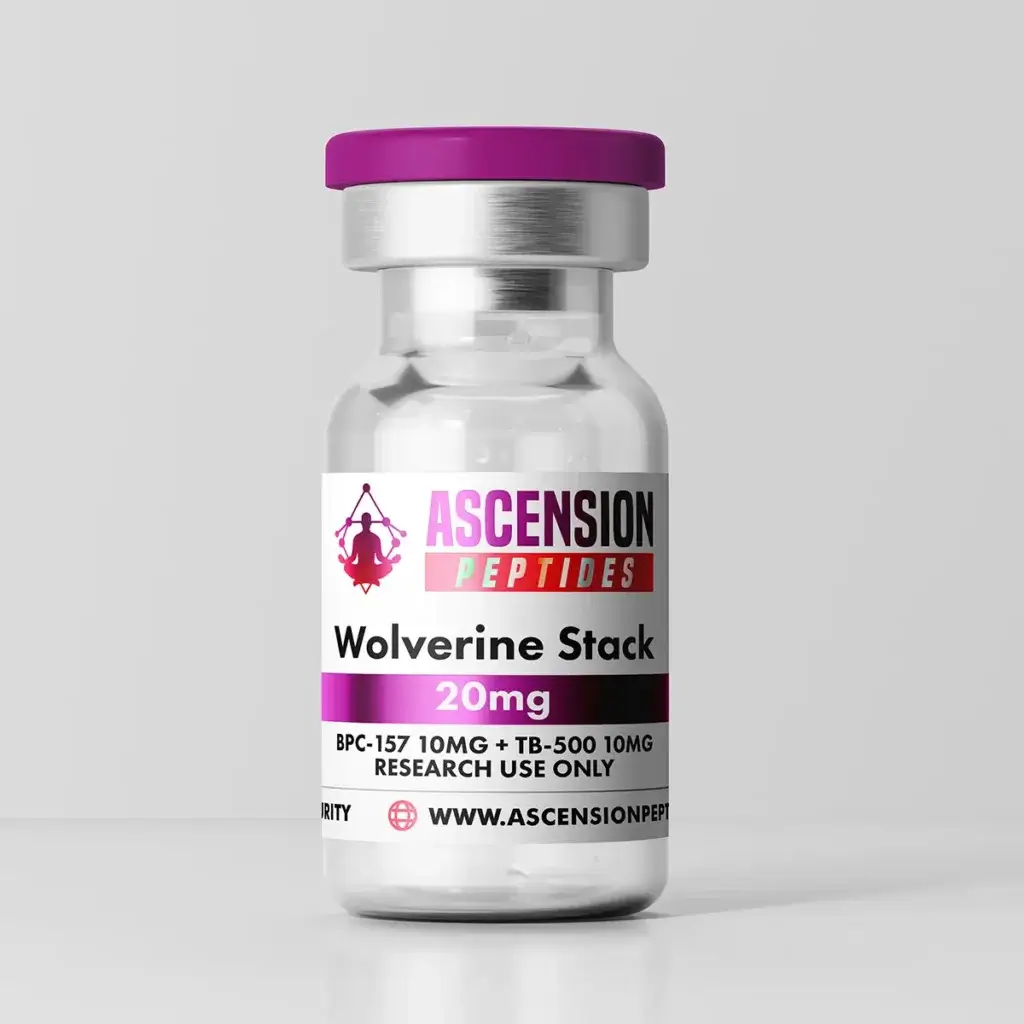

The Wolverine Stack refers to a synergistic pairing of BPC-157 and TB-500 (Thymosin Beta-4), both known for their regenerative and anti inflammatory effects that enhance recovery. Together, they appear to promote tissue regeneration, wound healing, and tendon healing in experimental research settings. These two peptides complement one another perfectly: while BPC-157 works as a body protection compound, TB-500 supports cell motility, angiogenesis, and the migration of cells into injured areas to help accelerate the healing process. For a full breakdown of how these peptides interact biologically, see How the Wolverine Stack Works (Mechanisms of BPC-157 & TB-500 Synergy).
The combination may have a promoting effect on tissue recovery and joint health, particularly for those dealing with sports injuries, post-surgical recovery, or chronic conditions that affect tendons, ligament healing, and muscles.
According to NIH studies, BPC-157 plays a key role in promoting angiogenesis (the growth of new blood vessels) and increasing growth hormone receptor expression, which supports tissue repair and may improve overall recovery time. Another study on thymosin beta-4 demonstrated its ability to promote cell migration, tendon fibroblast activity, and tendon outgrowth—a hallmark of advanced healing and tissue health.
The Science Behind BPC-157
BPC-157, short for “Body Protection Compound-157,” is a synthetic peptide derived from proteins naturally found in gastric juices. This small synthetic peptide fragment has shown a remarkable capacity to reduce inflammation, accelerate healing, and enhance tissue repair across multiple preclinical and in vitro models (MDPI).
Its potential role in promoting tissue repair stems from several mechanisms:
- Increasing growth factors that regulate fibroblast activity.
- Enhancing cellular migration and repair cells that close wounds faster.
- Protecting the stomach lining and improving blood flow to damaged tissues.
- Modulating nitric oxide and supporting the formation of new blood vessels that feed regenerating tissues.
By stimulating tissue regeneration, BPC-157 helps the body maintain overall tissue health while reducing inflammation and supporting joint health, muscles, and connective tissue.
For additional research-only dosing patterns discussed in scientific literature, see Wolverine Peptide Stack Dosage: A Comprehensive Guide.
The Science Behind TB-500 (Thymosin Beta-4)
TB-500 is a synthetic peptide derived from thymosin beta-4, a protein found naturally in almost every cell of the body. It is known for playing a key role in cell survival, cell migration, and angiogenesis, all of which are essential in the healing process. It also influences the production of AC-SDKP, a naturally occurring peptide fragment involved in inflammation reduction and tissue repair.
In animal studies (NIH), thymosin beta-4 has been shown to enhance wound healing, ligament healing, and muscle repair, and may even help with brain and nerve injuries. The promoting effect of TB-500 is thought to come from its ability to regulate actin, a structural protein that allows cells to move, divide, and repair damaged tissue.
Researchers also believe TB-500 helps patients with slow recovery, including those with brain injuries, by increasing cell motility and stimulating new blood vessels, making it particularly useful in advanced recovery protocols and chronic condition management.
Synergistic Effects: Why the Wolverine Stack Works
When combined, BPC-157 and TB-500 amplify each other’s effects, leading to a blend that supports advanced recovery, accelerated healing, and tissue regeneration. The synergistic effects can be summarized as follows:
- BPC-157 enhances growth hormone receptor expression, supports fibroblast activity, and helps maintain tissue health.
- TB-500 stimulates thymosin beta pathways, improves blood vessels formation, and boosts cell migration into injured areas.
- Together, they create a self-reinforcing loop of healing, repair, and inflammation reduction—resulting in stronger tendons, healthier ligaments, and faster tissue recovery.
For a deeper exploration of BPC-157 vs TB-500 individually, see Wolverine Stack vs Single Peptides (BPC-157 or TB-500 Alone).
These peptides are still being studied for their potential role in human treatment and disease applications. They are not FDA-approved drugs, but they are widely used in research and experimental settings to enhance understanding of healing mechanisms.
Frequently Asked Questions
What does BPC-157 do for your body?
BPC-157 supports tissue repair, tendon healing, and joint health by stimulating fibroblasts, increasing growth factors, and improving blood flow to injured areas. It can also help reduce inflammation and protect the stomach lining, playing a key role in the body’s natural healing and recovery functions.
Can I buy peptides over the counter?
Peptides like BPC-157 and TB-500 are typically sold for research purposes only and are not approved by the FDA for direct patient or human treatment. They are not considered supplements or medicines and should not be marketed for human consumption. However, you can buy peptides online from reputable vendors that clearly state their research use status.
For a full breakdown of legal classification in major countries, see Legal Status of BPC-157, TB-500 & Wolverine Stack (USA / UK / AU / CA).
How long does it take for BPC-157 peptide to work?
Based on available research and anecdotal reports, the healing effects of BPC-157 can often be felt within 1–3 weeks depending on injury severity, dosage, and individual response. While results vary, its ability to accelerate healing, reduce inflammation, and enhance tissue repair appears consistent across multiple studies on cells, tendons, and muscles.
What does the Wolverine blend do?
The Wolverine blend (BPC-157 + TB-500) is designed to promote advanced recovery, tissue regeneration, and tissue repair while reducing inflammation and improving joint health. By combining two regenerative peptides, it supports cells involved in wound healing, encourages angiogenesis, and helps repair tendons, ligaments, and muscles more efficiently. It’s often used in research exploring faster recovery for sports injuries and post-surgical patients.
Before you buy (recommended reading): Most “bad experiences” reported with peptides come down to dosing, handling, legality, or purity, not just the compounds themselves. These guides cover the key risk variables:
- Wolverine peptide side effects (known & theoretical risks)
- Is the Wolverine Peptide Stack safe? (best practices & cautions)
- Legal status (USA/UK/AU/CA)
- Gray-market vs pharmacy-grade sources (purity testing)
Conclusion
The popularity of Wolverine Peptide for sale isn’t surprising—it’s one of the most exciting peptide combinations for recovery, healing, and tissue regeneration treatment protocols. With BPC-157 acting as a body protection compound and TB-500 driving cell migration, angiogenesis, and repair, this wolverine stack offers a dynamic way to explore promoting tissue repair and advanced healing in research settings.
While these peptides show strong potential in preclinical and animal studies, particularly for certain disease model they are not FDA-approved drugs and should only be used for research or educational purposes. Still, for researchers exploring healing, joint health, and tissue recovery, the Wolverine Stack remains a fascinating subject with enormous promise.
For quality sourcing, Bioinfinity, Limitless Biotech, and Sports Technology Labs stand out as reliable vendors offering verified purity, fair pricing, and strong quality control—making them the go-to options for anyone seeking dependable research peptides online.


Reviews
There are no reviews yet.